
If you’ve looked at the news this week and thought:
“Well, there goes my plan to buy a house.”
You’re probably not alone.
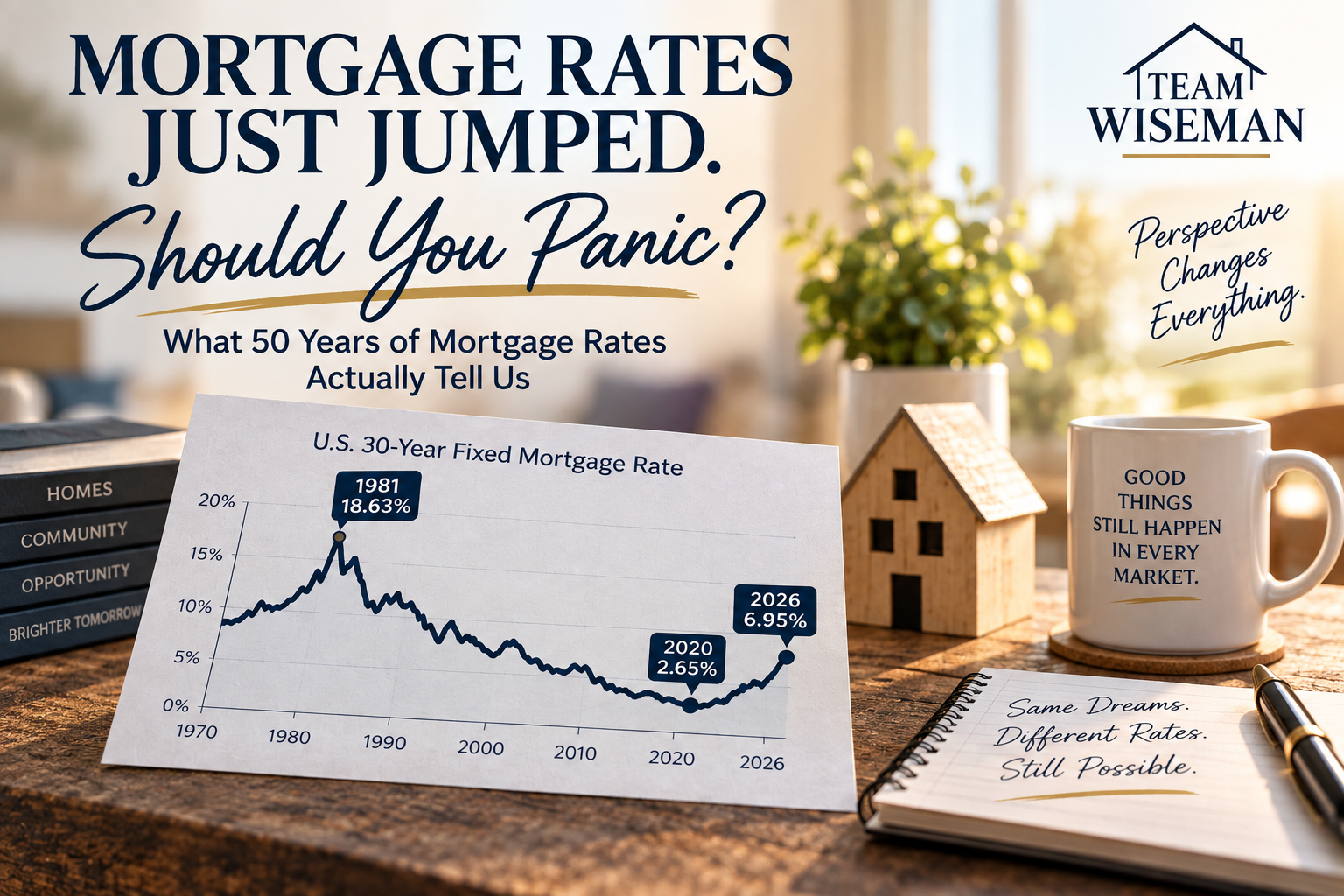
The Federal Reserve raised its benchmark interest-rate range by 0.25 percentage point this week, and mortgage rates have moved higher too. As of September 17, 2026, Freddie Mac reported the average 30-year fixed mortgage rate at 6.95%.
That’s up from 6.76% just one week earlier.
So yes—rates moved.
But before you decide that buying a home is officially off the table, there’s something we think every buyer should understand:
A 7% Mortgage Rate Is Not Historically Crazy
It just feels crazy because of what happened a few years ago.
For buyers who entered the housing market around 2020 and 2021, mortgage rates in the 2%–3% range started to feel normal.
They weren’t.
They were historically unusual.
In fact, Freddie Mac’s mortgage-rate data goes back to 1971, and the 30-year mortgage rate reached an astonishing 18.63% in 1981.
Yes. You read that correctly.
18.63%.
That doesn’t mean today’s rates don’t matter. They absolutely do.
It means we need some perspective before deciding what today’s rate means for your home purchase.
Why Mortgage Rates Matter So Much
Most buyers don’t actually buy a house based solely on its price.
They buy based on the monthly payment.
And interest rates have a direct impact on that payment.
Consider a $300,000, 30-year mortgage:
At 6.5%, principal and interest would be approximately $1,896/month.
At 7%, it’s approximately $1,996/month.
At 7.5%, it’s approximately $2,098/month.
At 8%, it’s approximately $2,201/month.
Taxes, insurance and other costs would be additional, but you can see the point:
Rates matter.
A higher rate can reduce your purchasing power or increase the payment on the same house.
But that’s only half of the housing-market equation.
Because Something Else Happens When Rates Rise
Buyers get scared.
Some postpone their search.
Some reduce their price range.
Some decide they’re going to “wait until rates come back down.”
And when enough buyers do that?
Competition can change.
Suddenly, instead of being one of eight offers on a house, you might be one of two.
Instead of automatically offering above asking price, there may be room to negotiate.
Instead of a seller saying “no” to closing-cost assistance, repairs or concessions, they may be willing to have the conversation.
That’s why focusing only on the interest rate can cause buyers to miss what’s happening everywhere else in the transaction.
Look at Topeka Right Now
The Topeka housing market isn’t collapsing.
Recent 2026 data puts the median sale price around $190,000, approximately 4.8% higher than the same period last year.
But homes are taking longer to sell than they were a year ago.
That distinction matters.
Prices can remain relatively strong while buyers simultaneously gain negotiating opportunities on individual properties.
And that’s exactly why real estate isn’t as simple as:
Rates went up = bad time to buy.
The 3% Mortgage Rate Had a Catch
Let’s talk about something people tend to forget when reminiscing about ultra-low mortgage rates.
Everybody else wanted those rates too.
Cheap borrowing increased purchasing power and helped fuel extraordinary buyer demand.
That meant buyers often faced:
Multiple offers.
Bidding wars.
Offers above asking price.
Limited negotiating power.
And, in some markets, buyers making aggressive concessions just to get their offer accepted.
A low interest rate is wonderful.
A low interest rate plus a wildly inflated purchase price and intense competition isn’t automatically wonderful.
The entire transaction matters.
You Don’t Buy an Interest Rate. You Buy a House.
This is one of the biggest mindset shifts we want buyers to understand.
Your purchase price is locked in.
Your mortgage rate doesn’t necessarily have to be.
If you buy a home today with a fixed-rate mortgage, your rate cannot suddenly increase because market rates increase later.
And if rates eventually decline enough to make refinancing financially worthwhile, refinancing may be an option depending on your circumstances, equity and qualification at that time.
There are costs involved, and refinancing is never guaranteed.
But it creates an important distinction:
You can potentially change the financing later.
You can’t go back five years later and renegotiate what you originally paid for the house.
What Happens If Rates Eventually Fall?
This is where things get interesting.
Lower mortgage rates generally increase purchasing power.
When buyers can afford more house for the same monthly payment, more buyers may enter the market or increase their budgets.
More demand can mean more competition.
And increased competition can put upward pressure on home prices, although there is never a guarantee that prices will rise.
So imagine two scenarios.
Buyer A waits.
Rates eventually fall.
They jump back into the market at the same time thousands of other buyers have the exact same idea.
Their payment calculation improves—but now they’re competing with more buyers.
Buyer B purchases when competition is softer.
They negotiate a price and terms that work for their budget today.
If rates later decline enough to make refinancing worthwhile, they explore refinancing.
And if increased demand contributes to home-price appreciation, they already own the asset.
Neither strategy is automatically right for everyone.
But “I’ll just wait until rates fall” isn’t a strategy without tradeoffs.
The Question Isn’t “Are Rates High?”
The better questions are:
Can I comfortably afford the payment today?
Am I planning to stay in this home long enough for buying to make sense?
What does the competition look like in my price range?
Can we negotiate the purchase price or seller concessions?
Does this home meet my needs?
What happens to my finances if rates don’t come down soon?
Those questions tell us far more than today’s headline.
Don’t Let a Headline Make a Six-Figure Decision for You
We’re never going to tell someone to buy a house they can’t comfortably afford because “rates might come down.”
Nobody knows exactly where mortgage rates will be next year.
But we also don’t think buyers should automatically abandon their plans because they saw an alarming headline about interest rates.
Sometimes the market everyone is afraid of entering creates opportunities for the buyers who understand it.
If you’re thinking about buying in Topeka, Silver Lake or the surrounding Kansas communities, talk with Team Wiseman before deciding you’re priced out.
Let’s run the numbers.
Let’s look at the houses.
Let’s look at the competition.
Then you can decide whether buying right now makes sense for you.