
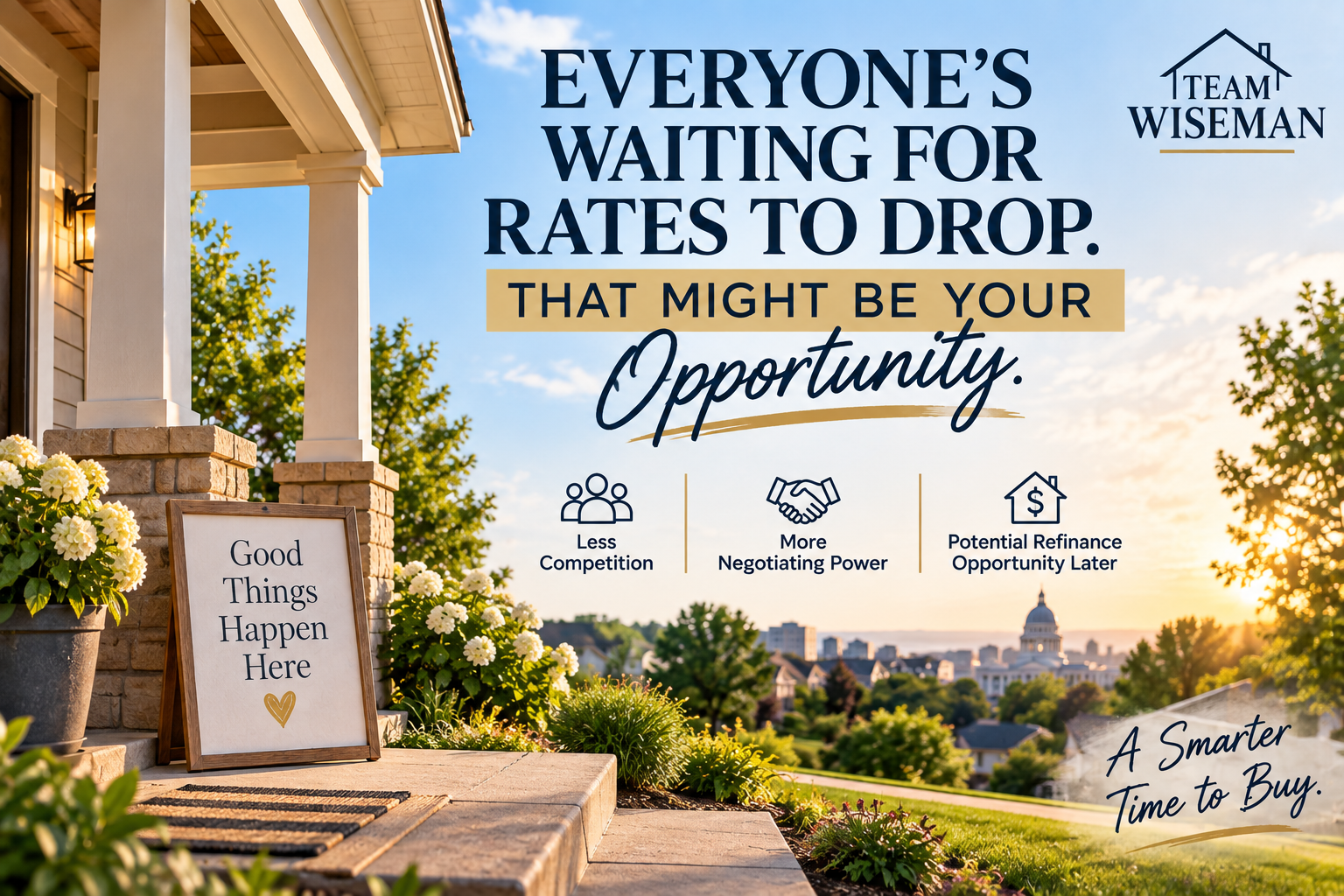
Here’s something you’re probably not hearing very often right now:
A higher-rate housing market can create opportunities for buyers.
No, we’re not going to pretend a 7% mortgage is cheaper than a 5% mortgage.
It isn’t.
Higher interest rates increase borrowing costs and can absolutely reduce what you can afford.
But your mortgage rate is only one variable in a home purchase.
And when everyone else becomes obsessed with that one number, smart buyers start looking at what changed everywhere else.
Higher Rates Can Push Some Buyers to the Sidelines
When rates jump, some buyers stop shopping.
That’s understandable.
But every buyer who decides to wait is potentially one less person competing against you for the same house.
And fewer competing buyers can change the negotiation dramatically.
Think about the difference between these two situations:
Market A
Twelve buyers want the house.
You may need to offer full price or above.
Seller concessions?
Probably difficult.
Repairs?
The seller has backup offers.
Time to think about it?
Not much.
Market B
Two buyers want the house.
Now the seller may care considerably more about keeping your offer together.
Maybe we negotiate on price.
Maybe we ask for allowable closing costs.
Maybe repairs become negotiable.
Maybe there’s room for other terms that would have been impossible in a feeding frenzy.
The interest rate is higher—but your leverage may be better.
Purchase Price Matters More Than People Realize
Here’s an important distinction.
You can potentially refinance a mortgage later.
You cannot refinance the price you paid for the house.
If you overpay by $25,000 during an extreme bidding war, that $25,000 doesn’t disappear when mortgage rates change.
That’s why the best buying opportunity isn’t necessarily the day mortgage rates hit their lowest point.
Sometimes it’s the period when other buyers are nervous enough that sellers actually have to negotiate again.
And Then There’s the Refinance Possibility
Suppose you purchase a home today at a payment you can comfortably afford.
If mortgage rates stay the same?
You’re already comfortable with the payment.
If they rise?
You have a fixed rate, assuming that’s the mortgage you selected.
If they fall substantially?
You may be able to explore refinancing.
That doesn’t mean refinancing is free or guaranteed. You’ll have to qualify, there may be closing costs, and the rate difference needs to be large enough to justify doing it.
But the possibility matters.
“I’ll Buy When Rates Drop.”
We hear this all the time.
But here’s the question:
What do you think every other buyer waiting for lower rates is going to do when rates drop?
They’re going to start looking too.
Lower rates increase purchasing power.
More purchasing power can bring more buyers into the market.
More buyers can create more competition.
And more competition can put upward pressure on prices.
So waiting for a lower rate can potentially solve one problem while creating another.
You may get the rate you wanted.
But you might be competing against six other people for the house you wanted.
Could Buying Now Create Equity Later?
Potentially.
But let’s be precise about what that means.
If you purchase a home at a favorable price during a period of softer demand and the property’s market value subsequently rises, the difference contributes to your equity.
Falling mortgage rates can stimulate buyer demand, and stronger demand can support higher home prices.
But appreciation isn’t guaranteed.
That’s why we don’t recommend buying a house based solely on the hope that it will rapidly increase in value.
Instead, we look for a house that makes sense at today’s payment and today’s value.
Future appreciation or a future refinance should be the upside—not the thing making an unaffordable purchase appear affordable.
There Are Other Ways to Improve the Numbers
Purchase price isn’t the only thing we can negotiate.
Depending on the property and loan program, we may be able to explore:
Seller-paid closing costs.
Seller concessions.
Interest-rate buydowns.
Repairs.
Closing timelines.
Lender credits.
Different loan programs.
That’s why a buyer shouldn’t look at a national mortgage-rate headline and conclude:
“I can’t buy.”
Let’s actually run the numbers first.
A Real Estate Market Is a Trade-Off
When rates were historically low, buyers loved the financing.
They didn’t necessarily love the competition.
When rates rise, buyers don’t love the financing.
But they may have opportunities elsewhere in the transaction.
There is rarely a housing market where the buyer gets everything.
The goal is figuring out which market gives you the best combination of affordability, negotiating leverage, selection and long-term value.
So…Should You Buy Right Now?
Don’t buy because someone tells you rates will fall.
Don’t wait because someone tells you prices will fall.
Nobody can promise either one.
Instead, ask:
Can I afford this home comfortably today?
How much competition is there in my specific price range?
Can we negotiate terms that improve the deal?
Would I still be happy owning this house if rates stayed where they are for several years?
If those answers work, today’s market may have more opportunity in it than the headlines suggest.
If you’re looking in Topeka, Silver Lake, Shawnee County or the surrounding area, Team Wiseman can help you run the actual numbers before you make the decision.
Because we’re not interested in convincing you to buy a house.
We’re interested in making sure you understand the market well enough to recognize a good opportunity when you see one.